
Yesterday I came across several posts referencing The Real Deal's coverage of Los Angeles County multifamily sales being up 55 percent. Articles like these lack nuance about what is actually happening in the market.
The Los Angeles multifamily sales recovery — as David Safai and a few others have noted — has been largely K-shaped. It has been concentrated in West LA submarkets, the San Fernando Valley, and the South Bay. Central Los Angeles and other markets subject to local RSO have seen values decimated, in some cases by as much as forty percent from 2021 highs.
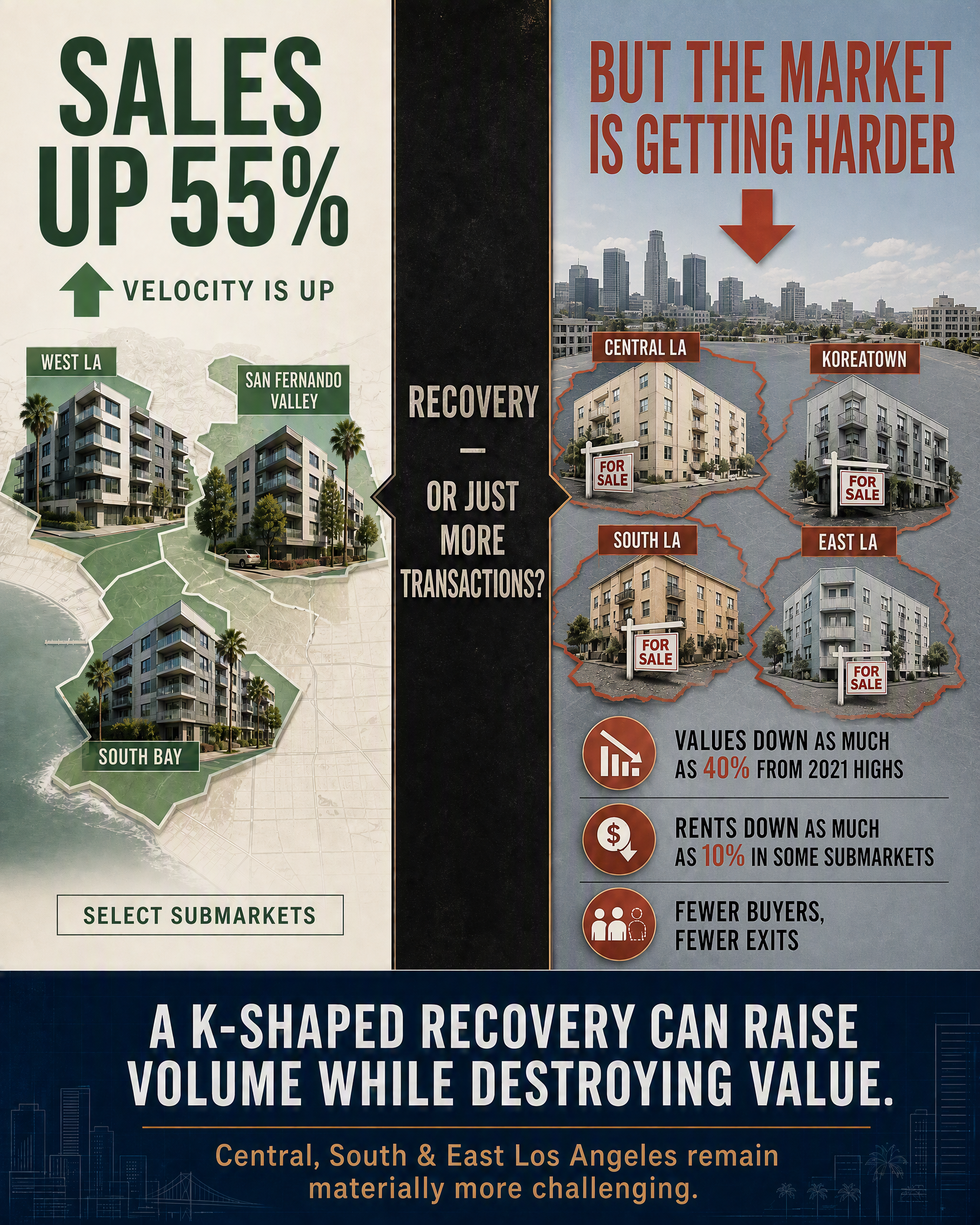
Two Markets, One Headline
Apartment building values east of La Brea — and especially south of the 10 freeway all the way down to Inglewood — are selling at levels not seen in Los Angeles in over a decade. Recent interest rate increases have made things even more challenging. A softening rental market, driven by recent ICE enforcement activity and broader economic headwinds, has exacerbated that value destruction. Rents have fallen in many submarkets by as much as ten percent over the past year, as thousands of units of new supply have come online at precisely the moment Los Angeles is losing population.
A Ground-Level Example
This morning I spoke with a broker and owner of an eight-unit apartment building in Koreatown. He mentioned that he had sold off most of his portfolio previously. The one remaining building was purchased in 2014 for $1.4 million. Today, it would be unlikely to sell for more than what he paid for it twelve years ago.
That value destruction is now touching non-RSO properties in non-A markets as well. Investor demand has cooled across the board, driven by higher borrowing costs, local regulatory exposure, and the lawsuit risk that comes with owning apartments in Los Angeles.
A Shrinking Buyer Pool
As a result, the buyer pool for many of these properties has thinned considerably — leaving owners, often older and from minority and immigrant backgrounds, with few if any viable exits.
I say this to say: as someone who is in the marketplace every day, it is hard to reconcile the posts from commercial real estate publications and data platforms suggesting the market is moving in a positive direction. Yes, velocity is up from the 2023–2024 lows. But transacting in this environment — particularly in Central, South, and East Los Angeles — has become materially more challenging.
A K-shaped recovery can raise volume while destroying value. Those are not the same thing, and conflating them does a disservice to the owners navigating this market right now.
David Evans is a commercial real estate broker specializing in multifamily investment properties across Los Angeles County.


